Earth system foundation models are reshaping how physical environments can be analyzed, interpreted, and ultimately financed. Systems trained on large volumes of satellite imagery, atmospheric data, ocean observations, radar signals, geospatial mapping, and climate records now synthesize previously fragmented measurements into coherent representations of terrain, environmental dynamics, and surface change through time. These models convert massive observational datasets into structured inference about the physical world.

Recent advances in Earth system foundation models are reshaping how physical environments can be analyzed, interpreted, and ultimately financed. Systems trained on large volumes of satellite imagery, atmospheric data, ocean observations, radar signals, geospatial mapping, and climate records now synthesize previously fragmented measurements into coherent representations of terrain, environmental dynamics, and surface change through time. These models convert massive observational datasets into structured inference about the physical world. In doing so, they transform dispersed signals into continuous analytical frameworks capable of representing land systems, climatic processes, vegetation patterns, hydrological behavior, and environmental variability at scales that were previously impractical to evaluate. What emerges is a more integrated understanding of the Earth as a dynamic system whose physical conditions can be observed, modeled, and updated with increasing precision.
This shift carries direct implications for the economic interpretation of physical assets. For much of modern capital market history, early stage real assets occupied a boundary between technical promise and financial credibility. Geological systems, agricultural corridors, energy sites, water constrained land systems, and infrastructure corridors could contain significant underlying value, yet the informational structure surrounding them remained incomplete. Observations were sparse, datasets were disconnected, and predictive frameworks were costly and narrow. As a result, the translation of physical potential into investable judgment occurred late in the asset lifecycle. Institutional capital typically entered once reserves were validated, operating feasibility demonstrated, permitting advanced, and cash flow visibility established. At that stage uncertainty had already compressed and a substantial portion of economic asymmetry had been repriced.
Foundation models alter the informational structure that historically delayed this transition. By integrating remote sensing imagery, climate histories, radar signals, geophysical data, and spatial observations into unified predictive systems, they render physical environments more analytically legible earlier in the lifecycle of an asset. Observational data that once appeared noisy or fragmented becomes part of a continuous representation of environmental behavior through time. Physical conditions that were once interpreted through isolated reports can now be evaluated within broader models of landscape dynamics, climatic interaction, and spatial correlation. In this framework uncertainty evolves from an opaque condition into a measurable distribution that can be updated as additional evidence accumulates.
For real asset capital formation this development carries structural consequences. The early life of a physical asset is fundamentally a problem of information and inference. Mineral systems begin as probabilistic interpretations of subsurface continuity and economic extractability. Agricultural land systems depend on yield variability, water access, soil response, weather behavior, storage integration, and logistical connectivity. Energy sites require assessment of resource quality, interconnection potential, environmental conditions, permitting progression, and construction feasibility. Infrastructure corridors emerge through geographic position, regulatory alignment, transport economics, and regional demand patterns. Each of these environments consists of interacting physical variables whose economic meaning evolves as information accumulates. Stronger predictive frameworks strengthen the analytical layer through which these variables are observed and interpreted.
Improved inference alters the sequencing of capital participation. Across many real asset industries, value creation occurs during stages of technical advancement long before assets reach stable operating status. Exploration programs refine geological understanding. Land consolidation clarifies agricultural production systems. Energy development progresses through site validation and infrastructure planning. Logistics corridors emerge through spatial positioning and regional integration. These stages gradually compress uncertainty through identifiable thresholds of technical evidence. Capital markets, however, have traditionally concentrated participation further downstream, when operating conditions resemble established infrastructure, stabilized real estate, or mature industrial assets. The result has been a persistent boundary separating assets perceived as speculative from those regarded as institutionally credible.
Advances in Earth system modeling shift this boundary. When large scale predictive models provide clearer representations of terrain, climate interaction, surface change, and environmental dynamics, the informational distance between early stage physical systems and disciplined underwriting narrows. Analytical clarity strengthens earlier in the lifecycle of land based assets. Geological distributions, land productivity patterns, hydrological dynamics, and infrastructure relationships can be examined within broader predictive contexts rather than through isolated observations. As analytical resolution improves, the stage at which capital can evaluate a physical system with confidence moves progressively upstream.
This upstream movement has particular significance in capital intensive sectors built around sequential technical advancement. Mining, agriculture, energy systems, industrial land development, water linked infrastructure, and logistics networks all follow staged maturity paths in which uncertainty declines as information accumulates. Each stage introduces new evidence that alters the probability distribution of outcomes. Where predictive frameworks remain weak, the transition from speculation to financial credibility occurs abruptly at late stages of development. Where analytical systems become stronger, that transition becomes more gradual, allowing the informational threshold for credible capital allocation to move earlier.
A more advanced geospatial intelligence layer therefore reshapes the economic geography of real asset investing. Physical environments once interpreted primarily through fragmented fieldwork and localized reports can increasingly be modeled through integrated Earth system representations. Satellite observation, temporal land change analysis, atmospheric modeling, radar imaging, and spatial data assimilation converge within unified analytical frameworks capable of representing the evolving state of the landscape itself. Capital allocation begins to engage with physical systems at earlier phases of uncertainty compression, guided by continuously updated inference rather than episodic interpretation.
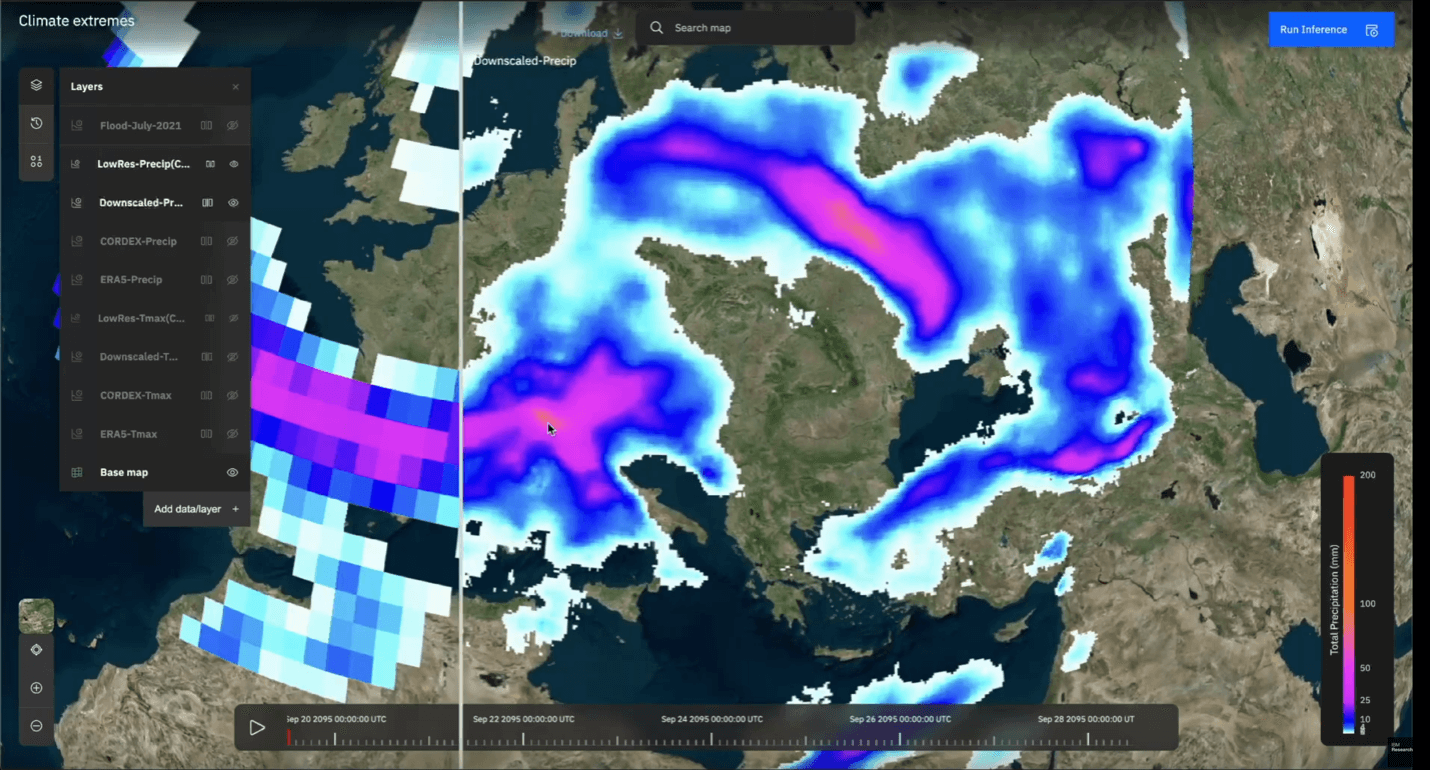
The growing predictive capacity of these models also connects directly to the operational realities that govern the success or failure of land based assets. Weather variability, drought cycles, flooding patterns, wildfire exposure, soil degradation, storm intensity, and shifting climate regimes have always shaped the economic outcomes of farms, mines, energy installations, and infrastructure networks. Agricultural yield depends on rainfall distribution, temperature variation, soil moisture dynamics, and seasonal timing. Mining operations face risks associated with water flows, landslides, extreme precipitation, and environmental stability. Energy systems depend on wind patterns, solar radiation, and climatic volatility across long operating horizons. Infrastructure corridors must account for flood plains, coastal erosion, and environmental hazards that evolve over decades. Foundation models capable of forecasting weather systems, identifying emerging environmental risks, and mapping land system dynamics provide a clearer view of these variables as they unfold through time. Predictive understanding of rainfall cycles, storm paths, drought probability, wildfire exposure, and hydrological behavior introduces a deeper layer of environmental intelligence into the evaluation of early stage assets.
Within an investment context, this predictive capacity strengthens the ability to assess the resilience and productive potential of physical systems before full development occurs. Agricultural land can be evaluated through long horizon climate signals and water availability patterns that shape crop yields. Energy sites can be analyzed through atmospheric modeling that clarifies generation potential and weather driven variability. Mining regions can be monitored for geophysical stability and environmental exposure that affect long term operations. Infrastructure corridors can be assessed through models that capture flood risk, terrain change, and environmental stress across decades of operation. Each layer of predictive insight converts environmental volatility into measurable variables that can be incorporated into structured investment judgment.
Within this environment the boundary separating speculative physical assets from institutionally credible ones gradually repositions itself. Land systems that once appeared informationally opaque become progressively measurable. Geological formations, agricultural productivity zones, water constrained environments, and infrastructure corridors reveal structured patterns across space and time. Analytical models illuminate relationships between environmental variables that were previously difficult to integrate. The frontier between uncertainty and investable clarity therefore shifts not because the underlying assets have changed, but because the tools used to understand them have matured.
For capital allocators this transformation elevates the importance of integrating geoscience, spatial intelligence, probabilistic modeling, and disciplined capital structuring within a single analytical process. Investment judgment becomes increasingly tied to the capacity to interpret physical systems as evolving datasets rather than static asset descriptions. Each new observation, satellite pass, subsurface measurement, environmental signal, or climate forecast updates the probabilistic understanding of an asset’s future economic potential. Allocation decisions align with the progression of evidence across identifiable stages of uncertainty reduction.
The broader consequence is a gradual repositioning of the center of gravity in real asset capital formation. As Earth observation systems, geospatial foundation models, and environmental prediction architectures continue to improve, capital gains the ability to engage earlier in the lifecycle of land based assets with greater analytical confidence. The frontier of investable real assets shifts upstream along the chain of technical advancement. Assets that previously remained outside the reach of institutional capital until late development phases become increasingly legible within earlier analytical frameworks.
In this sense the expanding predictive capacity of Earth system models carries economic significance well beyond environmental monitoring or weather forecasting. These systems reshape the informational foundation upon which physical assets are evaluated. As the Earth becomes more observable, measurable, and modelable through integrated data systems, the boundary between uncertain terrain and financeable opportunity continues to move. The frontier of capital allocation follows that movement upstream, tracking the growing capacity to translate physical complexity into structured investment judgment.


SKGP Strategic Partners
© 2026 SKGP Strategic Partners. All rights reserved. All proprietary frameworks, research, and materials are the intellectual property of SKGP Strategic Partners. Unauthorized use or distribution is prohibited.