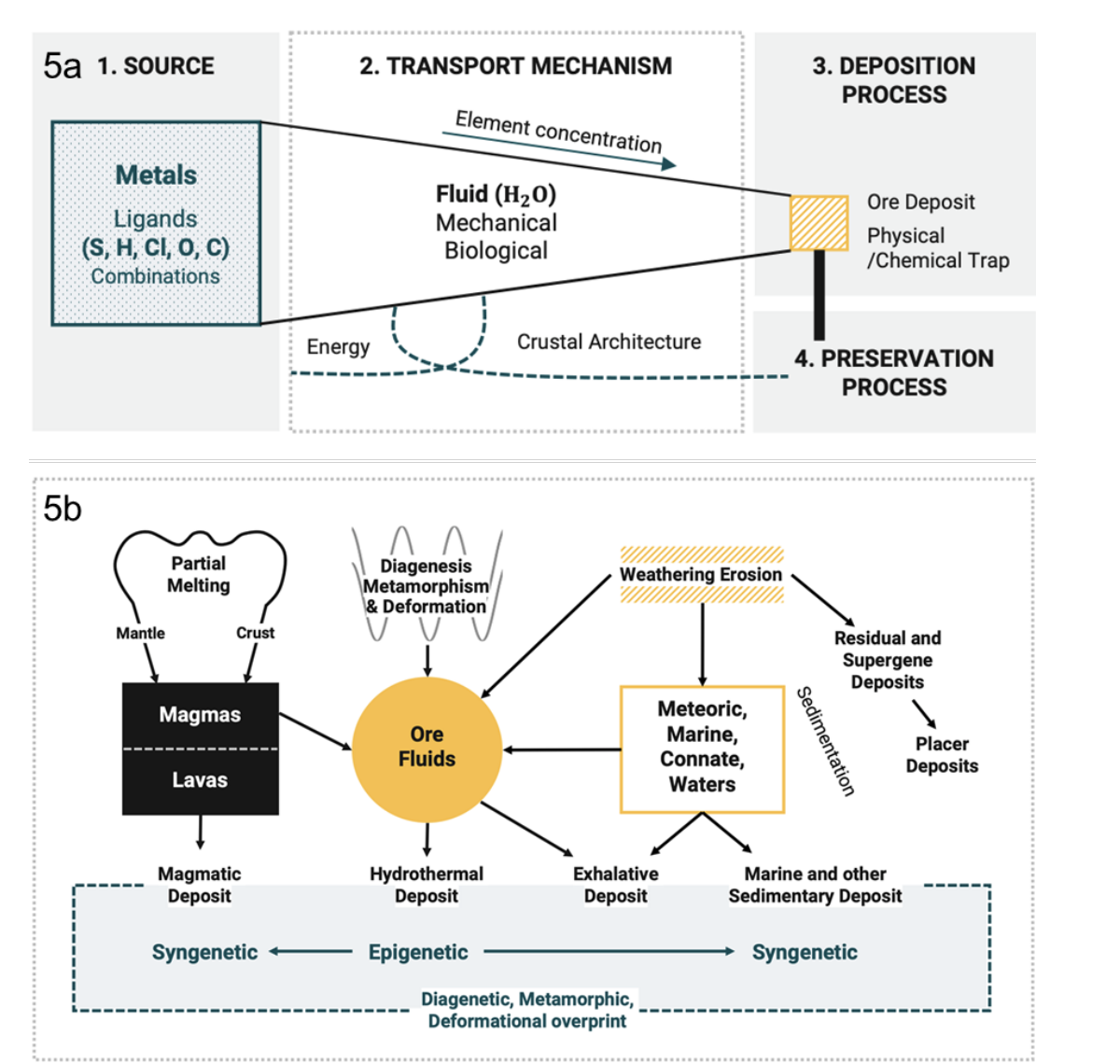
Movement of tectonic plates, subduction of oceanic crust beneath continental margins, circulation of hydrothermal fluids, and the burial of organic matter under precise pressure conditions established the distribution of metals, hydrocarbons, and mineral inputs that continue to support industrial production today. Copper deposits concentrated along volcanic arcs, hydrocarbons trapped within sedimentary basins, phosphates formed in marine environments, and potash deposited in evaporative systems are outcomes of both economic demand and geological history.

The modern economy is typically described through markets, capital allocation, and policy decisions, yet those descriptions begin far too late in the sequence of events that actually determine how the system functions. Long before trade routes, financial instruments, or industrial networks existed, the earth had already determined where the foundational inputs of that system would reside. Movement of tectonic plates, subduction of oceanic crust beneath continental margins, circulation of hydrothermal fluids, and the burial of organic matter under precise pressure conditions established the distribution of metals, hydrocarbons, and mineral inputs that continue to support industrial production today. Copper deposits concentrated along volcanic arcs, hydrocarbons trapped within sedimentary basins, phosphates formed in marine environments, and potash deposited in evaporative systems are outcomes of both economic demand and geological history. Even helium, despite its abundance in the universe, remains rare on Earth because it cannot escape the atmosphere unless captured within specific subsurface traps, often alongside natural gas systems. The physical economy therefore rests on a foundation that is both spatially fixed and historically determined, creating a structure in which supply is inherently constrained and cannot be relocated or reproduced in response to price signals or policy intervention.
This constraint carries forward into the earliest stages of assets, where what is commonly referred to as a “project” is simply an interpretation of earth. Exploration is the process through which fragments of geological evidence are assembled into a coherent model, starting with surface expressions such as geochemical anomalies, and geophysical contrasts that suggest the presence of a system below. These signals are indirect and incomplete, requiring interpretation rather than providing certainty. Drilling alters the nature of the system by introducing direct evidence, yet even at that stage the transition remains partial. It is one point within a much larger spatial framework that must be filled in through repeated sampling, tighter spacing, and the gradual construction of continuity. As more data is collected, uncertainty reduces, and the system becomes legible in terms of size, grade, geometry, and economic potential. In regions where decades of prior work have already taken place, where mapping, sampling, and partial development have accumulated over time, confidence in the presence of mineralization can become high before new drilling begins, shifting attention toward delineation and extraction rather than discovery. The transition from geological idea to economic asset therefore unfolds in stages defined by information density, with value emerging as uncertainty is progressively reduced rather than appearing at the outset.
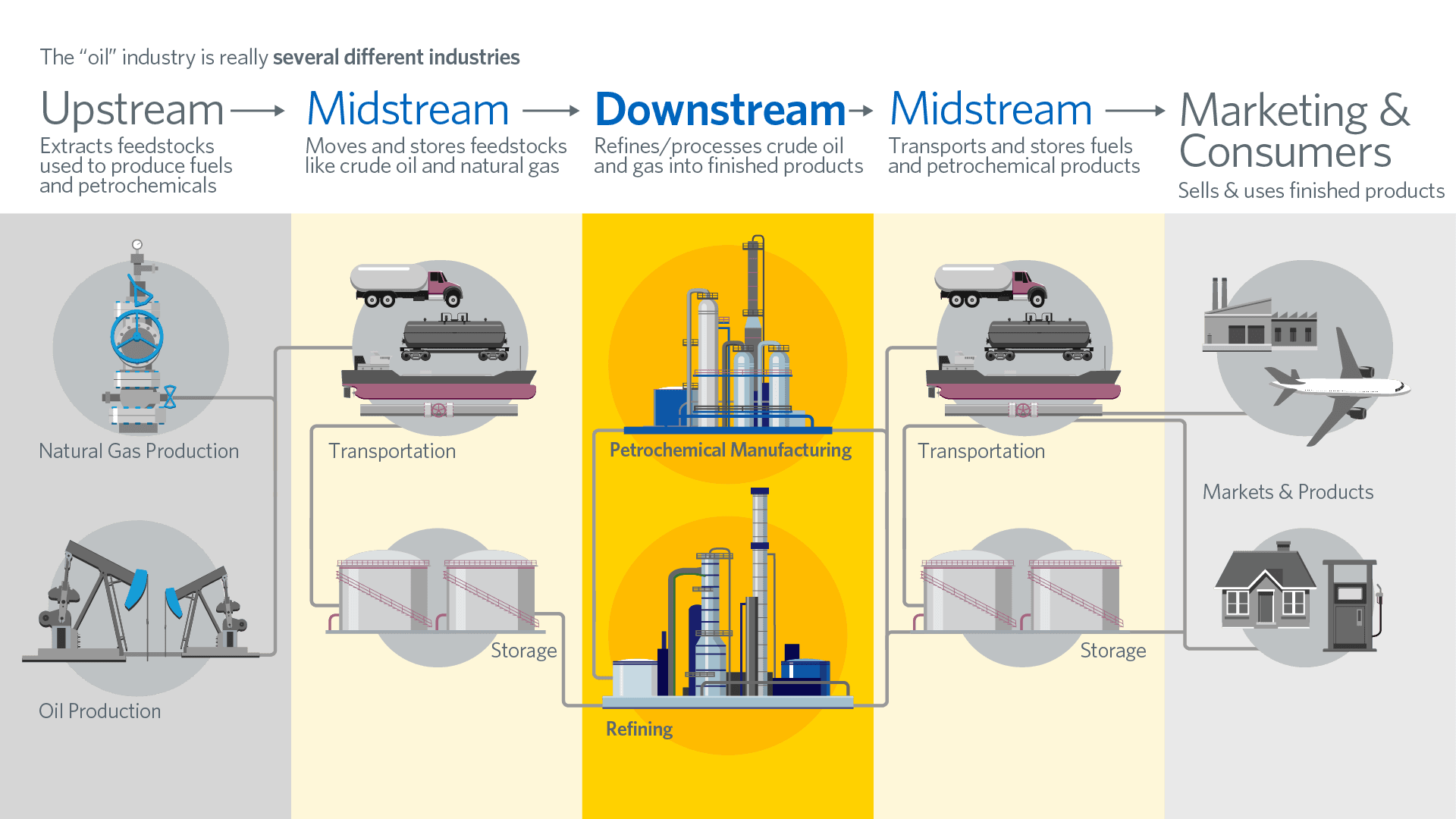
Once extracted, materials do not enter the economy in their raw form but pass through a series of transformations that integrate them into a broader industrial system. Hydrocarbons provide the clearest example of this process because of their centrality to a network of products that extend far beyond energy. Oil and natural gas are transformed into intermediates such as ethylene, propylene, ammonia, and aromatic compounds, each of which serves as a building block for a wide range of downstream products. Plastics derived from ethylene permeate packaging, electronics, and medical devices. Synthetic fibers derived from propylene underpin textiles and industrial materials. Ammonia, produced through energy intensive processes tied to natural gas, forms the basis of nitrogen fertilizers that sustain agricultural production. This structure is not linear chain but an interconnected web in which a single input supports multiple industries simultaneously. As a result, disruptions at the level of feedstocks propagate outward through the system, linking energy markets to manufacturing, food production, and consumer goods in ways that are often not immediately visible.
The significance of geopolitical pressure emerges within this context as a constraint on movement rather than a driver of price. Maritime corridors such as the Strait of Hormuz function as critical nodes through which a substantial share of global energy and feedstock flows pass, embedding them deeply within the structure of industrial production. When flows through such routes are disrupted or even perceived to be at risk, the effects extend across multiple layers of the economy. Diesel price increases transmit into transportation, construction, and agricultural operations. Constraints on natural gas availability affect ammonia production and, by extension, fertilizer supply. Tightening naphtha flows influence petrochemical output and plastics manufacturing. These adjustments do not occur independently but reinforce one another as they move through interconnected systems. Helium provides a particularly clear example of how dependency operates within this structure. Although it represents a negligible portion of the cost of semiconductor production, it plays an essential role in specific manufacturing processes. Its supply is highly concentrated and largely tied to natural gas production, with limited inventory buffers and no practical substitutes. When availability is constrained, production halts regardless of price, demonstrating that the system is governed less by cost sensitivity than by functional necessity.
Agriculture reveals the same structure in a more immediate and tangible way, as modern food production depends on inputs that are themselves products of global energy and mineral systems. Nitrogen fertilizer relies heavily on natural gas, while phosphates and potash depend on mining and processing within geographically concentrated regions. When these inputs become constrained, whether through energy disruptions, trade limitations, or logistical bottlenecks, fertilizer availability declines and prices increase, placing pressure on agricultural output. Recent movements in urea, ammonia, and related inputs illustrate how quickly these effects can materialize, with sharp price increases reflecting underlying constraints in feedstock availability. What begins as a disruption in energy or mineral supply is transmitted into food systems, linking geopolitical events to food security through a chain of dependencies that is often overlooked. At the same time, localized alternatives such as organic fertilizer derived from biomass and agricultural residues begin to take on greater importance, not as marginal improvements but as structural adjustments that reduce exposure to global supply constraints and shorten the distance between input production and end use.
The structure of global supply chains amplifies these dynamics. Over several decades, production and processing were optimized for efficiency, concentrating activity in regions with cost advantages and reducing inventories to minimize capital tied up in storage. Redundancy was removed in favor of streamlined operations, and intermediate stages of production became geographically clustered. This configuration performs effectively under stable conditions but introduces fragility when disruptions occur, as concentration increases exposure to localized shocks and limited inventories reduce the capacity to absorb disturbances. The recurrence of trade disruptions over recent years suggests that such shocks are no longer exceptional events but recurring features of the system, with implications for inflation, currency stability, and growth. In this environment, resilience becomes a defining characteristic of system design, shaping decisions around sourcing, inventory management, financing, and the development of alternative pathways where feasible.
Historical patterns provide additional context for understanding how these systems evolve over time. The development of the East Texas Oil Field offers a clear example of how resource abundance, rapid expansion, and market dynamics interact. Intense production during the early phases of development led to oversupply and price collapse, prompting state intervention to stabilize output. Over time, the region transitioned from a center of extraordinary activity to a landscape marked by its industrial past, with infrastructure and memory persisting even as economic relevance declined. Such patterns reflect the broader lifecycle of resource systems, where periods of expansion are followed by adjustment and eventual transformation, leaving behind both physical and economic traces that shape subsequent development.
Taken together, these elements describe a system in which geological constraint, uncertainty reduction, industrial transformation, and geopolitical pressure operate as interconnected layers. Materials formed through deep time processes become assets through the gradual accumulation of information, are integrated into industrial networks through chemical transformation, and are distributed across global supply chains that are both efficient and fragile. Disruptions at any point in this system propagate through multiple layers, ultimately appearing as inflation, shortages, or shifts in economic activity. Capital enters this structure unevenly, often concentrating in later stages where uncertainty has already been reduced, while earlier stages remain underfunded despite their role in creating future supply. The resulting imbalance reinforces the fragility of the system, as the processes that generate new resources and reduce uncertainty receive less attention than those that operate within established frameworks. The economy that is observed at the surface is therefore the final expression of a much deeper system, one that begins in the Earth and moves through successive layers of transformation before appearing as price, product, and policy.


SKGP Strategic Partners
© 2026 SKGP Strategic Partners. All rights reserved. All proprietary frameworks, research, and materials are the intellectual property of SKGP Strategic Partners. Unauthorized use or distribution is prohibited.